Nine Hours, Fifty-Five Minutes
Tyler Andrews left Everest Base Camp at 7:11 in the evening on 27 May and climbed into the dark. Just before dawn the next morning, at 5:06, he stood on the summit at 8,848 metres. Nine hours and fifty-five minutes. Iconics records it plainly: the fastest ascent of the world's highest mountain, from Base Camp to summit, ever measured.
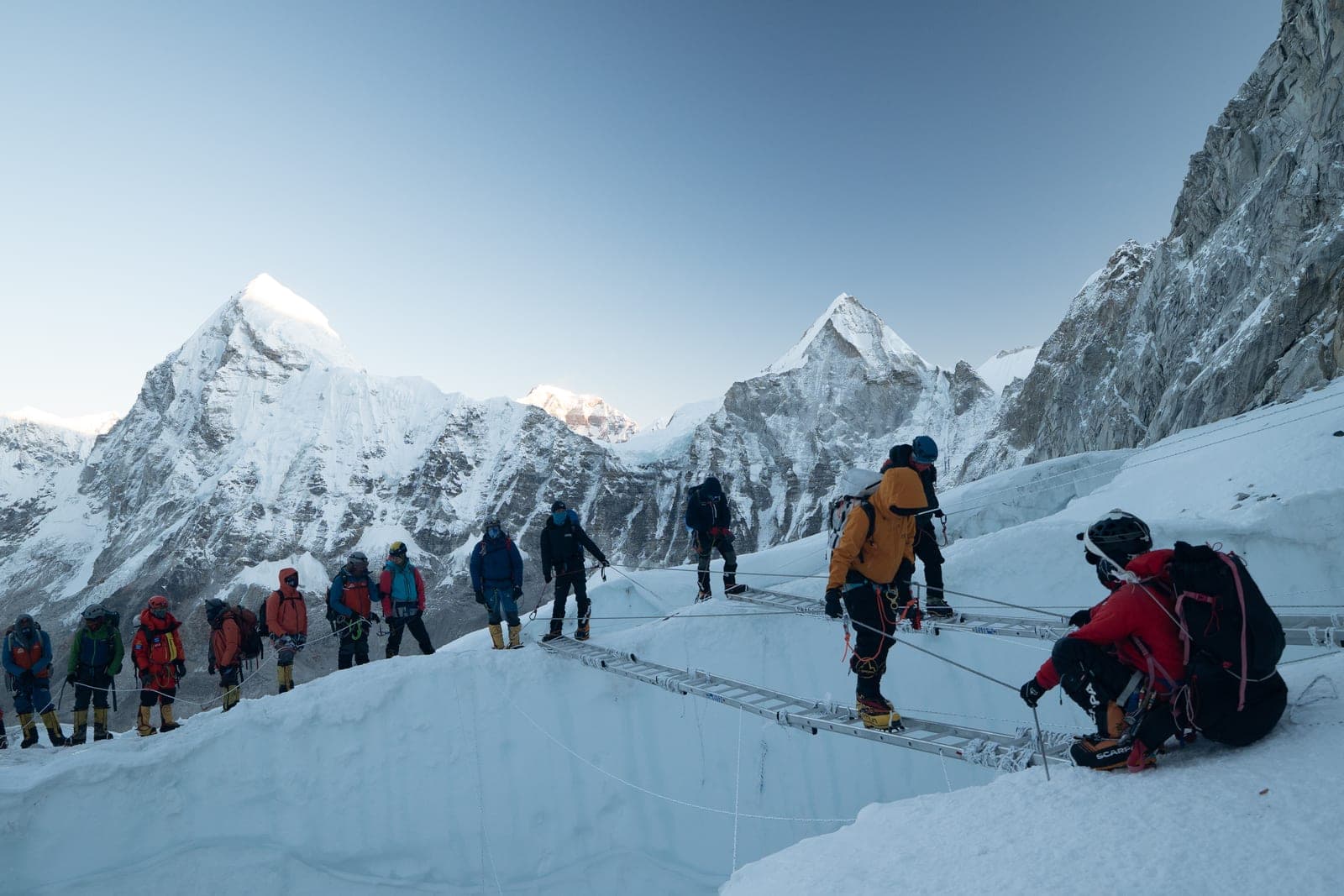
The margin is the story. Andrews beat the record of ten hours and fifty-six minutes, held since 2003 by the Nepali climber Lhakpa Gelu Sherpa, by more than an hour. He did not stop there. He returned to Base Camp in sixteen hours and thirty-two minutes, cutting nearly two hours from the previous round-trip mark of eighteen hours and thirty. The route was the Southeast Ridge. He covered roughly 29 kilometres and 3,821 metres of ascent and descent, a passage that takes expedition parties five to seven days.
He used supplementary oxygen from Camp 2 upward, the same aid Gelu Sherpa had. He climbed largely alone, through the night, so that he would have daylight to descend the world's highest mountain safely. There was little room to choose the day. Andrews knew the mountain would close on the 29th; with only three days left, the 28th was the last possible window, and he took it.
Six Times Before
This was the seventh attempt. His sixth bid had ended near 26,000 feet, turned back by worsening weather and logistics. The earlier failures ran deeper than a single season. Andrews had first chased a purist, oxygen-free record on the harder north side, before China closed that approach and pushed him to the south. The pivot to bottled gas drew questions, and he met them directly.
"No, it doesn't take anything away from me. They are different marks, but I can't tell that one is harder than the other from an athletic perspective. Going to the summit in 9h55, and back in 16h32, is one of the hardest things I've ever done," he told ExplorersWeb.
The 36-year-old from Concord, Massachusetts, arrived at Everest by an unusual road. He won the Javelina 100k and placed 15th at the Leadville 100 in 2021, took second at the IAU 50k World Championships in 2016, and won the USATF 50-mile title in 2019. In recent years he turned to the high peaks, holding round-trip fastest known times on Manaslu and Ama Dablam. Everest was the summit that kept refusing him.
Until the night it did not. Tyler Andrews had reached the South Summit, for the first time in his life, at four that morning. An hour later he stood higher than anyone has stood faster.