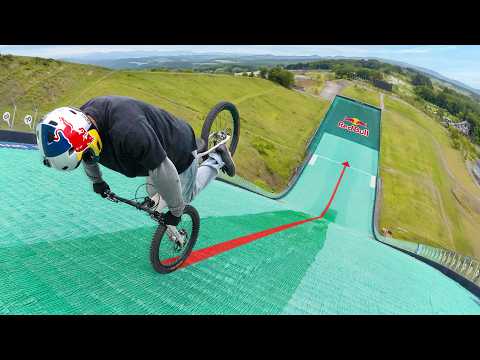
On 27 May 2026, Tomomi Nishikubo pointed his bike backwards down an Olympic ski jump and let go of everything except balance. He descended the Hakuba hill on the front wheel alone, a fakie nose manual held across 136.6 metres of a 37.5-degree face, at more than 60 km/h. No one had done it before. When the run was ratified, it carried two Guinness World Records.
How the run was decided
The Hakuba jump is built to send ski jumpers into the air, not to be ridden down in reverse on one wheel. That is the difficulty. A fakie nose manual asks the rider to travel backwards, weight pitched forward over the front tyre, the rear wheel lifted and useless. On a flat surface it is a control trick. On a 37.5-degree incline it becomes a fight against gravity, speed and the smallest error of the wrist. Nishikubo had to hold the position not for metres but for the full length of the in-run, the point where the slope tries hardest to throw the bike out from under him. Past 60 km/h, with nothing behind him to see, the margin was the width of a contact patch.
The distance and the gradient are what the records recognise: the steepest bicycle fakie nose manual, and the longest distance travelled by bicycle fakie nose manual on a ski jumping hill. Both were set in the same descent. One run answered two questions that no rider had answered before.
The road to a world first
The landing did not arrive quickly. Nishikubo spent two years on the idea and made roughly fifty full-course attempts before the run held together. That is the part the numbers hide. Each attempt meant carrying the bike back up a ski jump, resetting the position, and trusting the same balance that had failed before. A world first in bike trials is rarely a single moment of nerve. It is the accumulation of failures, each one narrowing the distance between what is possible and what is not.
For Nishikubo, the feat sits at the far edge of trials riding, a discipline built on precision and patience rather than airtime. His command of balance had been shown in smaller arenas before. Hakuba took that same skill and stretched it across an Olympic slope, turning a controlled trick into a descent measured in records. The feature was released by Red Bull in July 2026, and the footage did the rest.
Two years, fifty attempts, one run held to the bottom. Tomomi Nishikubo now owns a line no rider had drawn before.