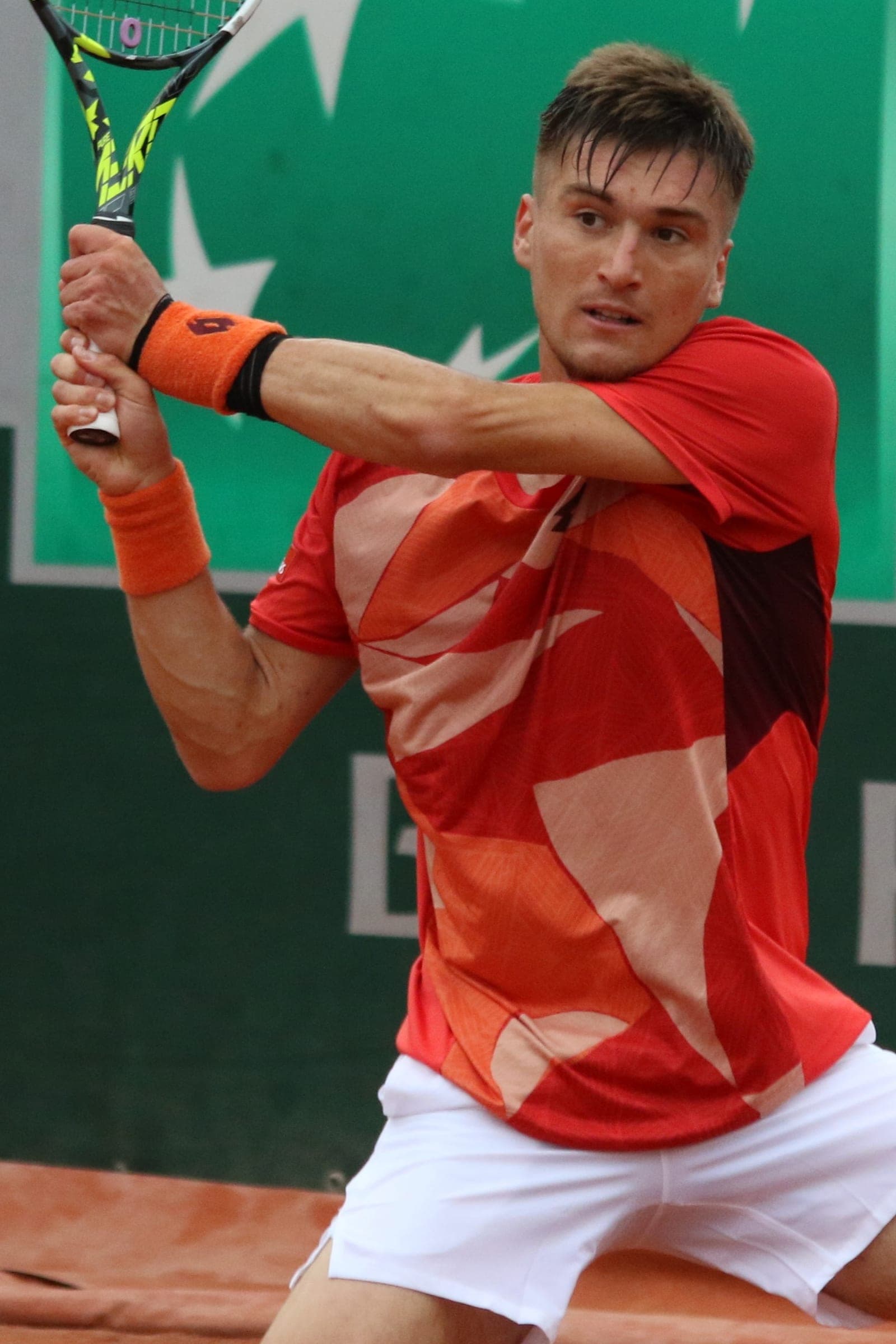
Jakub Menšík walked to the net on Court Philippe-Chatrier a Grand Slam semifinalist. The scoreboard read 6-4, 6-3, 7-6(3). On June 2, 2026, the Czech had become the first player born in 2004 or later to reach the last four of a major, and the youngest Czech of the Open Era to stand at that threshold, past a line drawn by Ivan Lendl in 1981.
The quarterfinal carried a particular symmetry.
On Court Philippe-Chatrier, Menšík met João Fonseca
, the young Brazilian cast alongside him as the sport's coming generation. Two players of the same age, seeded within places of one another, arrived at the same stage of the same tournament to decide which of them would go on.
How it was won
Menšík settled first. He took the opening set 6-4, holding through the early exchanges and finding the one break that mattered. The second followed the same shape, 6-3, the margin widening as his serve steadied and Fonseca's errors gathered. The Czech built his tennis around that serve, the shot that has carried him this far, and let the points come short.
The third set refused to break cleanly. Fonseca held on, and the two went to a tie-break with the match, and the semifinal place, resting on it. There Menšík was the calmer man. He reached 7-6(3), closed the set and the contest, and left the clay with the win intact in straight sets.
The shape of a career
Clay was not meant to be the surface on which this arrived first. Menšík's game was read as a hard-court instrument, built on power and a serve that rewards flatter, faster courts. His breakthrough at that level came earlier, in the sweep of the indoor and quicker seasons, and Paris asked different questions of him: longer rallies, higher bounce, more patience between the big points.
That is what makes the run at Roland Garros a step rather than a repeat. He has taken the parts of his game that travel and learned to wait for the rest. The victory over Fonseca was not a single afternoon's form. It was the reward of a player widening the ground he can win on, at an age when most are still learning the tour.
He now stands one of four left in Paris, the youngest among them, with the record already his whatever follows. For a player still measured against the promise of his generation, the semifinal is proof that the promise has begun to keep itself.
The clay held his name a little longer than anyone expected. He did not seem surprised.