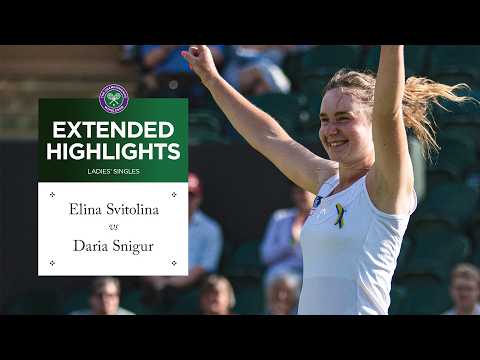
Daria Snigur trailed 0-4 in the opening set. Then, on 30 June 2026, on an outside court at the All England Club, she stopped losing and started dictating. Ninety minutes of tennis condensed into sixty-eight, and by the end the No. 8 seed was walking off in the first round. Snigur, ranked 77th in the world, beat her compatriot Elina Svitolina 7-5, 6-2 to open Wimbledon 2026.
How the match turned
The early games belonged to Svitolina. The seed moved cleanly, held serve, and pressed. Snigur found nothing. Four games to love, and the match looked settled before it had begun. What followed was a slow correction. Snigur lowered her contact point and flattened her strokes, driving the ball low over the net so that Svitolina had to bend and lift from below the tape. The pace stayed heavy. The margins shrank. From 0-4 down, Snigur took the set 7-5, breaking back through the middle of it and closing it out under pressure.
The second set carried none of the first set's doubt. Snigur held the initiative from the baseline, redirecting Svitolina's depth and taking time away with early, biting groundstrokes. She broke, consolidated, and broke again. Svitolina, Ukraine's leading player and one of the tournament's protected names, had few answers to the flat trajectory and the tempo. Snigur closed it 6-2. On the grass, where low balls stay low, her game found its most natural surface.
A step back into the light
The result reset a personal timeline. It was Snigur's first win over a top-10 opponent since 2023, a marker of how long she had spent circling the edges of the tour rather than its centre. The Kyiv-born player had made her name early with a run of junior success and an eye-catching Grand Slam upset in her first senior seasons, then found the years that followed harder: ranking that drifted, matches that slipped away from winning positions, the slow work of rebuilding without the shelter of a seeding.
This match answered the pattern directly. The old fragility would have surrendered at 0-4. Instead she held her nerve and her method, and the scoreline hardened in her favour the longer the contest ran. Beating Svitolina — a semi-finalist of real pedigree at this event, and a fellow Ukrainian she has measured herself against for years — gave the win a weight beyond the draw sheet. It moved her into the second round and, more than that, back into a conversation she had drifted out of.
Careers are not straight lines. Snigur has known that longer than most. On this afternoon, from four games down, she made the line bend her way again.