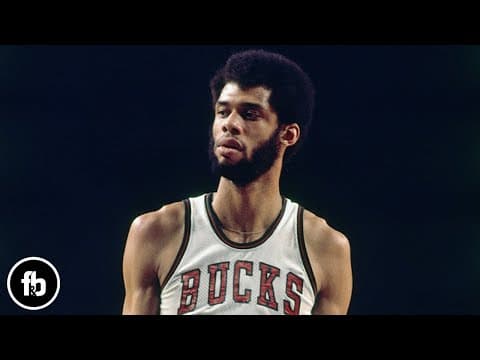
No shot in basketball history carried the same quiet certainty as the skyhook. Kareem Abdul-Jabbar did not simply add a move to the game’s catalogue; he refined a high-release, one-handed arc into an essentially unblockable weapon that defined a 20-year career.
A hook that touched the clouds
The shot’s roots were humble. As a grade-schooler already a foot taller than his classmates, Abdul-Jabbar drilled the Mikan Drill, a cycle of left- and right-handed layups. A standard hook shot emerged from that repetition, but his growing frame transformed it, lifting the release so high above the rim that the motion earned its name — the skyhook.
At UCLA, the NCAA outlawed the dunk in 1967 partly because of his overwhelming power near the basket. Deprived of one scoring option, he leaned harder into the hook, leading the Bruins to three consecutive championships while averaging 26.4 points per game.
Seventeen feet, and a city silenced
The move’s most dramatic test came on the Boston parquet in 1974. Game 6 of the NBA Finals stretched into a second overtime after John Havlicek erased a Bucks lead twice with late jumpers. With seven seconds left, Havlicek struck again, a rainbow over Abdul-Jabbar for a 101-100 Boston edge.
Champagne stood ready in the corridors. The Bucks called time and drew a play for Jon McGlocklin, but the design broke down. With the ball on the right block and no passing lane open, Abdul-Jabbar dribbled baseline, turned, and lofted a 17-foot skyhook over Boston center Hank Finkel. It dropped clean through with two seconds remaining — 102-101, Milwaukee.
Abdul-Jabbar scored 34 points that night. Though Boston regrouped to win Game 7, the image of the hook hanging in the Garden air had already entered basketball’s permanent memory.
A shot no one could touch
Standing 7-foot-2, he used his body as a shield. Not Wilt Chamberlain, not Bill Russell, not Hakeem Olajuwon could reach the release point. “It was the only shot I could shoot that didn’t get smashed back in my face,” he told reporters. “I learned to rely on it early.”
The stroke accounted for a dominant share of his 38,387 career points, carrying him to six MVP awards and six championships. A record that held the summit for nearly 34 years rose, arc by arc, from a boy’s search for a shot that would not be knocked back.