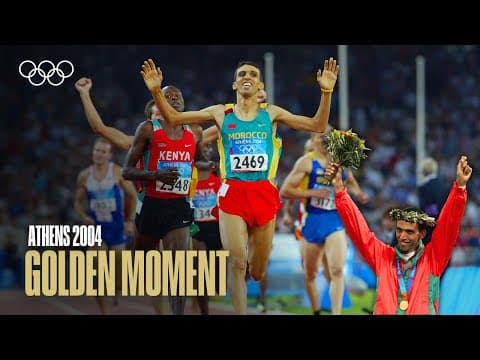
On a warm August night in Athens, Hicham El Guerrouj of Morocco finally claimed the Olympic 1500m gold medal that had eluded him for eight years. He crossed the line in 3:34.18, defeating Kenya’s Bernard Lagat by the narrowest of margins.
A duel decided in the final fifty metres
The final began tactically, the field easing through a slow opening lap of over sixty seconds. El Guerrouj moved to the front at 800m and wound the pace tighter, a third lap of 53.28 seconds stringing out the contenders before the bell. At 1200m he still led, but Bernard Lagat was waiting.
With a hundred metres to run Lagat launched his attack and surged past the Moroccan with seventy metres left. For a moment the ghosts of Sydney loomed, but El Guerrouj drew level and found a kick that nobody could match. He retook the lead inside the final twenty metres and won by 0.12 seconds, his closing 800m clocked at a ferocious 1:46.70 — the fastest ever run in an Olympic 1500m final.
Eight years of waiting and a double for the ages
The gold completed a journey that had begun with a fall in the 1996 Atlanta final and continued with silver behind Noah Ngeny in Sydney 2000. El Guerrouj arrived in Athens not as the overwhelming favourite but as a man carrying the weight of two missed chances, his season complicated by allergy problems and a defeat to Lagat in Zurich weeks earlier.
He dropped to the track after the finish, kissed the surface and wept. Then he embraced Lagat and his coach before finding his three-month-old daughter Hiba in the crowd. “This is the greatest day of my life,” he told reporters afterwards. “I simply did not want to lose.” Lagat offered his own tribute: “I gave 100% and El Guerrouj gave 101%.”
Four days later El Guerrouj won the 5000m gold, becoming the first man since Paavo Nurmi in 1924 to complete the Olympic middle-distance double. The world record holder over the mile and 1500m had finally turned his dominance into the prize that mattered most.